Uninterrupted Water Supply Secured as SAGE Future‑Proofs 54 Remote WA Sites
SAGE delivered a major modernisation program across 54 remote Water Corporation sites, with seamless integration of new 4G, IP radio, PLC, and...
CASE STUDY
Managing water diversions across a broad geographic area presents a significant operational and regulatory challenge.
Melbourne Water is responsible for monitoring water drawn from natural waterways by license holders for irrigation purposes, requiring compliance with the water allocation limits while maintaining transparency and efficiency.
Historically, many diversion flowmeters relied on manual readings and site visits, providing limited usage data and increasing operational effort.
In Victoria, water corporations own, operate and maintain all non-urban water meters. A state-wide policy meant Melbourne Water had a requirement that all active flowmeters have telemetry installed.
With a diverse fleet of flowmeter assets already in place, Melbourne Water required a scalable telemetry solution that could integrate with existing infrastructure, support regulatory reporting, and reduce the reliance on physical meter readings, all while operating across hundreds of geographically dispersed and often difficult-to-access sites.
Under Melbourne Water’s Operational Technology Maintenance and Project Delivery (OTMPD) program, SAGE was engaged to deliver the Diversions Flowmeter Telemetry project, an end-to-end rollout of remote monitoring across existing diversion assets.
Acting as principal contractor, SAGE managed project delivery, site access coordination, technical integration, commissioning, and end-to-end testing across the program.
Many of the sites were located on private land, requiring close collaboration and flexibility in scheduling both site audits and installation works.
The project involved the installation of Kallipr Captis S2 dataloggers on 252 flowmeters across 215 sites, covering a wide range of device models including Arad, Siemens, Krohne and Bermad meters.
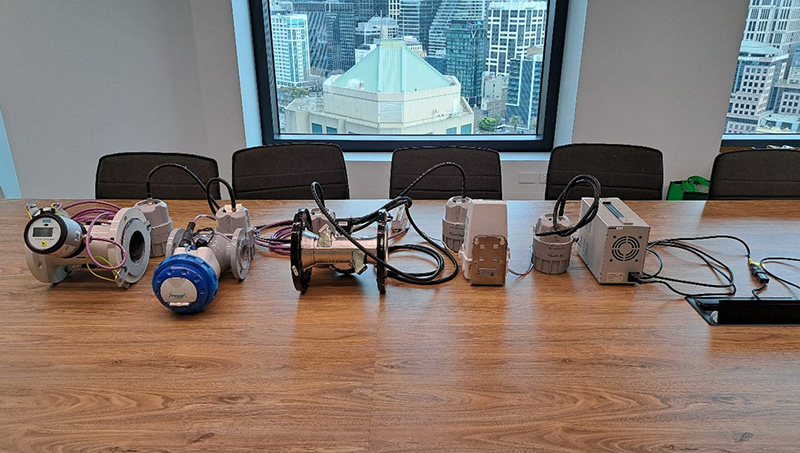
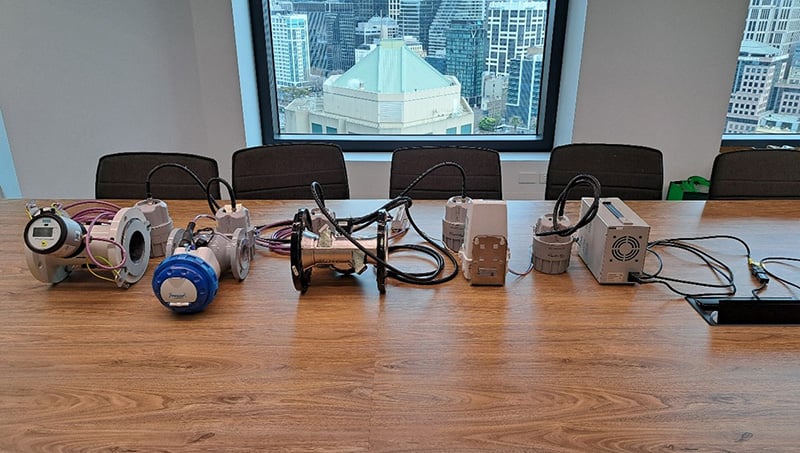 Pictured above: FAT Testing with Flowmeters connected to a Kallipr Captis datalogger unit via Modbus. Flowmeters L-R: Siemens MAG 8000, Krohne Waterflux, Arad Octave and Siemens MAG 6000.
The solution enables secure, remote capture and transmission of flow data via the Kallipr Kloud platform, providing Melbourne Water with greatly improved visibility of water consumption against licensed allocations.
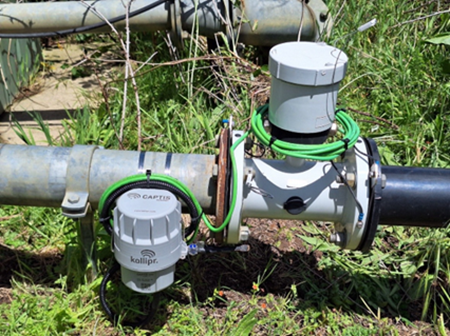 Pictured above: A typical installation with a new Kallipr Captis Datalogger
installed and connected to an existing Siemens MAG8000 Flowmeter
SAGE managed the delivery from early technical evaluation through to the installation and commissioning.
This included site audits, bench testing and factory acceptance testing (FAT) across multiple flowmeter types, followed by a staged rollout beginning with pilot sites and scaling to a full deployment.
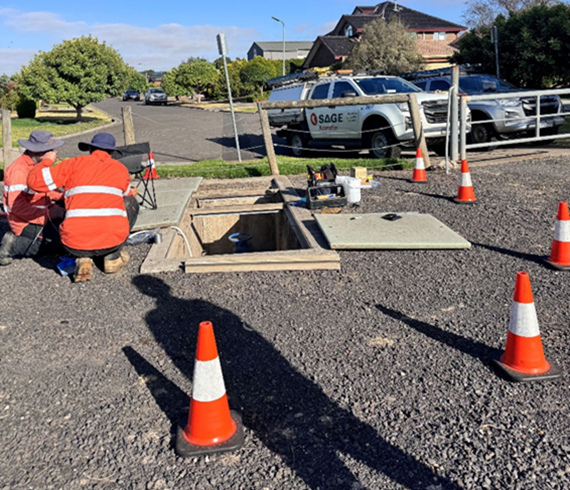 Pictured above: SAGE team completing an on-site installation
The project has delivered a robust and future-ready telemetry solution at scale.
Remote monitoring now reduces the need for manual meter reading, improves data accuracy and timeliness, and strengthens Melbourne Water’s ability to manage compliance across its diversion network.
Despite some challenges of site access constraints, environmental conditions, device variability and commissioning refinements, the project maintained momentum.
SAGE demonstrated a practical, scalable approach to modernising water monitoring infrastructure for existing assets.
252 flow meters spread across 215 sites – installation and commissioning works completed by Automation Technicians within SAGE’s Field Services team.
Successful navigation of practical and technical complexities, including site access constraints, weather impacts, vegetation around meters, battery and hardware issues, cable compatibility on some units, and data or platform refinements during commissioning.
Water use across these waterways can now be monitored accurately and continuously, enabling more consistent compliance oversight and giving licence holders direct, real-time visibility of their own consumption data.
SAGE delivered a major modernisation program across 54 remote Water Corporation sites, with seamless integration of new 4G, IP radio, PLC, and...
Following the 2013 closure of their water treatment plant, residents of Linville needed a new facility to ensure a fresh water supply. Find out how...
Find out how SAGE Automation delivered an upgraded automated system for a regional city council’s pumping stations while maintaining operation of the...