 Christian Chong-White
SAGE Contributes to Key Industry Conversations at ITS Australia Summit 2026
How is technology helping to make our transport routes more efficient and safe? Here are some of the key insights from ITS Australia Summit in 2026.
ARTICLE
3 min read
At ITS World Summit 2026, Christian Chong-White explored how applying a Movement and Place framework to traffic signal operations could improve pedestrian experience, reduce delays and create more community-focused outcomes. Through simulation and analysis of a real-world site, the presentation demonstrated how relatively simple changes to signal behaviour can significantly improve place-based outcomes without major infrastructure investment.
Christian Chong-White, Principal Consultant, presented this thought-provoking session that challenged some of the most fundamental assumptions underpinning traffic signal design and operation. Rather than viewing intersections purely through the lens of vehicle efficiency, the presentation explored how the Movement and Place framework can help create traffic environments that better reflect the needs of people, communities, and places.
For decades, traffic signal design has primarily focused on moving vehicles efficiently through the network. While this approach has delivered significant benefits for mobility, it has also shaped an environment where pedestrian movements are often treated as secondary considerations.
The presentation posed several challenging questions:
Why do traffic signals typically default to serving vehicles when no demand is present?
Why are pedestrians often required to actively request a crossing while vehicle
movements are continuously accommodated?
Why do we invest heavily in vehicle detection yet rarely detect pedestrian demand with
the same sophistication?
Should traffic signals near schools, train stations and town centres operate differently
from those on movement-focused arterial roads?
These questions form the basis of a broader vision: reimagining traffic signal spaces to balance
movement, place, safety and user experience rather than prioritising vehicle throughput alone.
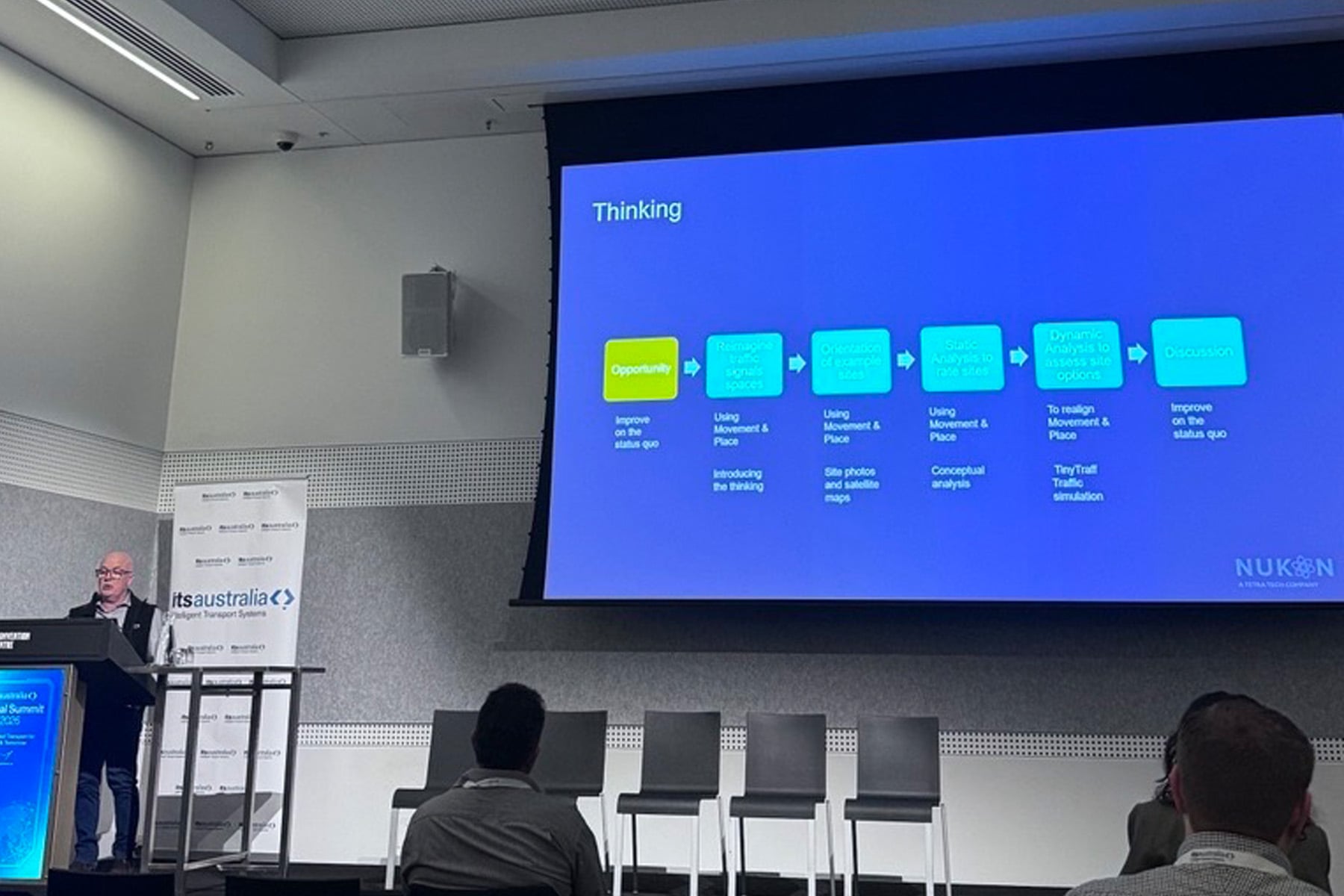
Pictured above: Christian Chong-White presenting at ITS. Christian's presentations covered the role that traffic signals play in modern transport networks and, as a co-presenter for Hold on Heavy, a look at how intelligent infrastructure can improve safety and efficiency for freight operators and other road users.
The Movement and Place framework recognises that roads and intersections serve multiple functions. Some locations are primarily about moving people efficiently, while others are destinations where community activity, accessibility and amenity are equally important.
To explore how this thinking could influence signal operations, Christian introduced a concept called the Movement & Place (M&P) Adaptive Traffic Signals Service Rating.
The framework evaluates traffic signal operation against several dimensions, including:
Signalised movements
Protected movements
Resting states
Green phase skipping
Re-sequencing
Adaptive operation
Balancing of competing demands
The objective is to assign a "Place Score" that indicates how strongly a traffic signal configuration supports place-oriented outcomes.
The presentation examined pedestrian crossings near Lindfield Train Station and the Lindfield Town Centre on Sydney's North Shore. The site provides an interesting contrast between movement-oriented and place-oriented environments.
Using the M&P rating methodology, the team assessed a pedestrian crossing on Lindfield Avenue. Under its existing operation, the crossing rested on green for vehicles and only activated for pedestrians when requested. Static analysis produced a Place Score of approximately 40%.
The team then explored a simple but powerful alternative: reversing the default behaviour so the crossing would rest on walk rather than rest on green. This change shifted priority towards pedestrians while still maintaining adaptive traffic operation. Under the revised configuration, the Place Score increased to 80%.
Using TinyTraff, our traffic simulation platform, the proposed changes were tested over a two-hour simulation period.
The results were significant. Under the existing operation, the simulated road user Place Score was 24%, with pedestrians experiencing long waits and higher stop times.
Following the introduction of the rest-on-walk operating philosophy:
Overall Place Score increased from 24% to 49%
Longest pedestrian wait time reduced dramatically
Average pedestrian delay decreased
Total pedestrian stop time reduced
The overall user experience became more balanced across all modes.
Importantly, these improvements were achieved through operational changes rather than major infrastructure upgrades. The exercise demonstrated how relatively modest adjustments to signal logic can produce meaningful benefits for people-focused environments.
The presentation also explored the technologies needed to support more place-responsive traffic signal operation. Capabilities such as advanced vehicle detection, radar and LiDAR sensing, upstream demand monitoring, optimisation-based control algorithms and sophisticated movement control methodologies all create opportunities to better balance the needs of different road users.
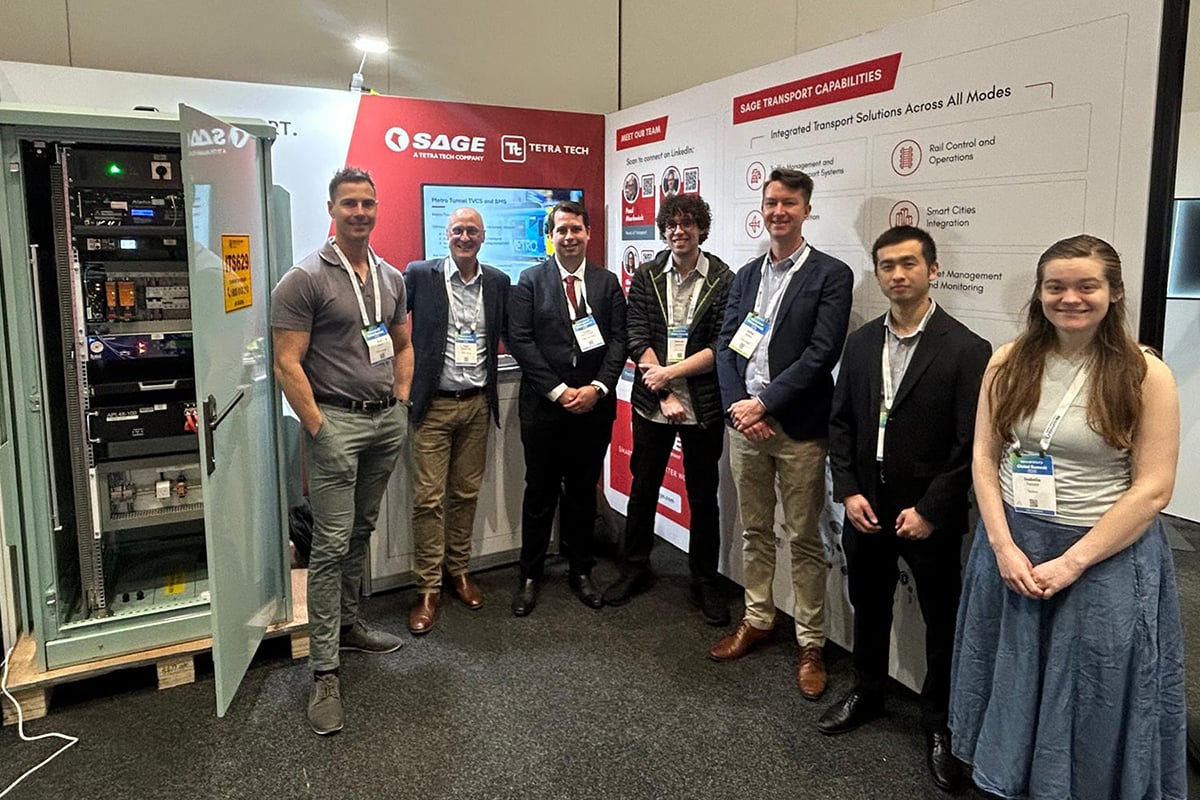
Many of these concepts align with projects and capabilities already being explored by SAGE Group, including advanced vehicle detection systems, transit priority solutions, movement control methodologies and simulation-based testing environments
One of the core messages from the session was that improving transport outcomes is not always about building more infrastructure. Sometimes the greatest opportunity lies in rethinking how existing infrastructure behaves
By applying a Movement and Place lens to traffic signal operation, transport agencies can begin to create intersections that are more responsive to their surrounding communities and better aligned with modern expectations of accessibility, safety and urban experience.
As cities continue to evolve, the challenge is no longer simply moving vehicles efficiently through an intersection. It is creating transport environments that balance movement with place and support the needs of all users.
Interested in more insights like this? Subscribe to The SAGE Signal for the latest updates and exclusive highlights from across SAGE Group.
How is technology helping to make our transport routes more efficient and safe? Here are some of the key insights from ITS Australia Summit in 2026.

SAGE Automation's Senior Systems Engineer and resident smart cities expert Ashby Martin explains how the City of Marion is using smart sensors in...
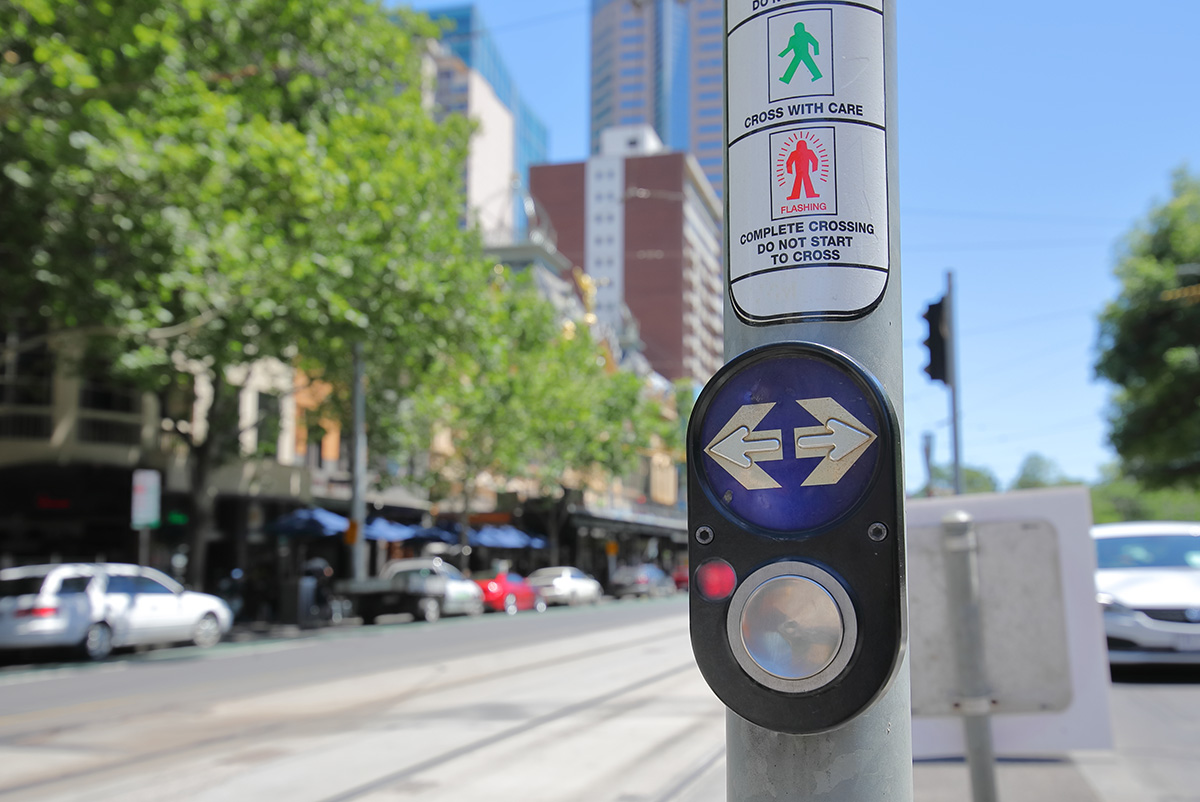
Pedestrian buttons at traffic signals feature accessibility in their design, an important consideration for creating inclusive and safe environments.